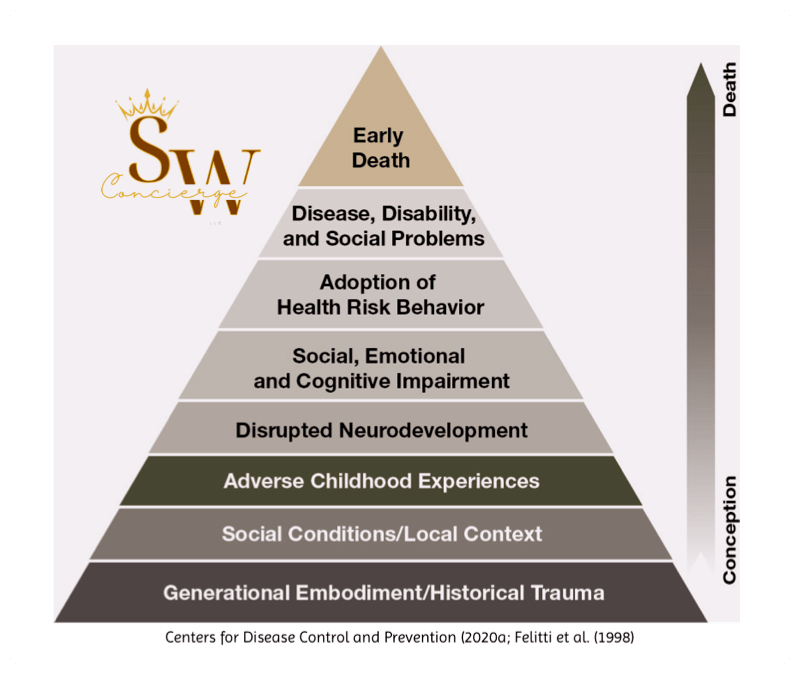

🧠 The experiences we have in childhood shape the adults we become. But what happens when those experiences are traumatic? The ACE Pyramid, developed by the CDC and Kaiser Permanente, helps us understand how early adversity leads to disrupted development, risky behavior, chronic illness, and even early death. At The Social Work Concierge, LLC, we use this framework to help clients and professionals heal from the inside out — because healing begins with understanding.

📊 What Are ACEs?
Adverse Childhood Experiences (ACEs) are stressful or traumatic events that occur before age 18. These include:
- Physical, emotional, or sexual abuse
- Physical or emotional neglect
- Household disfunction, such as:
- Parental mental illness
- Substance use
- Incarceration
- Intimate partner violence
- Divorce or separation
Research shows a dose-response relationship — the more ACEs one has, the greater the risk of serious health and social problems.
📊 Signs of ACEs Throughout the Lifespan
| Life Stage | Potential Impact |
|---|---|
| Infancy & Early Years | Delays in speech, emotional dysregulation, attachment issues |
| Adolescence | Risk-taking behavior, school problems, identity confusion |
| Adulthood | Chronic health issues, relationship challenges, anxiety |
| Older Adulthood | Cognitive decline, disability, social withdrawal and isolation |
🔺The ACEs Pyramid Explained
The ACE Pyramid illustrates the pathway from childhood adversity to life-long consequences.
1. Generational Embodiment / Historical Trauma
Trauma is not just personal — it’s generational. We inherit trauma from our parents and grandparents. Experiences like racism, colonization, gender biases, systemic poverty, and community violence become embedded in family systems. Trauma is in our DNA.
2. Social Conditions / Local Context
Environmental factors such as poverty, housing insecurity, lack of access to healthcare, and educational inequality increase vulnerability to ACEs. These are socio-economic and political issues, many of which we only have limited control.
3. Adverse Childhood Experiences (ACEs)
This is the direct exposure to the traumatic conditions described above – parental separation, abuse, neglect, and household dysfunction. Remember, the more ACEs a person experiences, the greater the risk for negative outcomes in adulthood — unless healing relationships, protective environments and healthy coping skills are provided.
4. Disrupted Neurodevelopment
Chronic stress alters the developing brain, especially in areas responsible for emotional regulation, decision-making, and memory. This means can make it difficult to focus, learn, and develop age-appropriate social skills.

5. Social, Emotional, and Cognitive Impairment
As a result of altered brain function, both children and adults may struggle with school, employment, relationships, and emotional stability. Individuals often describe feeling “frustrated”, “stuck”, or “hopeless” when this occurs.
6. Adoption of Health-Risk Behaviors
To cope, many adopt harmful behaviors: smoking, overeating, binge shopping substance use, gambling, or risky sex. As mentioned above, healing relationships, protective environments and healthy coping skills can reduce the negative consequences of risky behaviors.

7. Disease, Disability, and Social Problems
Over time, these unhealthy behaviors and stress patterns contribute to conditions like heart disease, autoimmune disorders, and incarceration. Anxiety, depression, and post traumatic stress disorder are common conditions that may require behavioral health support so they don’t worsen.
8. Early Death
Without intervention, the cumulative impact of ACEs can shorten life expectancy by up to 20 years. That’s why it’s important to understand the various ways ACEs impact human development.
🌱 Breaking the Cycle
The ACE Pyramid shows that trauma is not a moment — it’s a system. And systems require intentional disruption to heal. Here’s the good news: ACEs are not your destiny. With the right support, it’s possible to build resilience, rewire the brain, and break harmful cycles. Whether you’re a client healing from trauma or a social worker guiding others, understanding the ACEs empowers you to change the narrative. At The Social Work Concierge, LLC, we incorporate this model by doing the following to promote healing:
- Create safe, affirming relationships
- Learn to regulate our nervous systems
- Develop healthier coping tools
- Acknowledge generational and systemic trauma
- Choose to evolve — not repeat
✨ Evolve or Repeat
Whether you’re a professional helping others or an individual seeking healing, understanding the ACEs Pyramid gives you a roadmap to change unhealthy patterns caused by trauma.
Let’s evolve — not repeat.
📍 Accepting New Clients (Insurance + Self-Pay)
🔗 www.SocialWorkConcierge.com
📩 Book Your Free Consultation Today
The Social Work Concierge, LLC
Luxury Support for Mental Wellness & Professional Growth
 The Social Work Concierge, LLC
Leave a comment